
The best base for MMA is Combat Sambo. Anyone who argues otherwise is being foolish, as Combat Sambo trains you everything from striking, to wrestling to grappling. The best striking base for MMA however has been up for debate for years. In ye olden times, the idea was you either focused on boxing and wrestling, or muay thai and BJJ. Everyone would learn submission defence but the wisdom of the time was that a kicker needed a more emphasis on a guard in case they were taken down.
The two most effective styles for MMA are Muay Thai and Sanda with little debate. K-1 style kickboxing is too limited and lacks the grappling focus of the other two styles. While there are a handful of K-1 stylists to make their way into MMA, the overwhelming majority of fighters train Muay Thai at least to some degree. Sanda has relatively little representation in MMA but the few fighters who have used it are exceptional.
So let’s weigh them up and decide what is the stronger base.
MUAY THAI

Muay Thai refers to the national sport of Thailand and several other martial arts throughout south east Asia which are the same martial art but practised under different names. In the west it’s often associated with it’s low kicks, but in actuality the main staple strike of Muay Thai are the highly scoring body kicks. Being practised in a ring means that Muay Thai fighters become very adept at cutting off the arena and pressuring opponents
While everyone thinks of low kicks in relation to Muay Thai, the art’s primary advantages against other striking styles are the emphasis on knees, elbows and clinch work – which when combined with wrestling for MMA allow for a very complete fighter. A great example in MMA would be Matt Brown, who is able to keep himself standing thanks to his wrestling and absolutely maul his opponents in the clinch with elbows.
SANDA
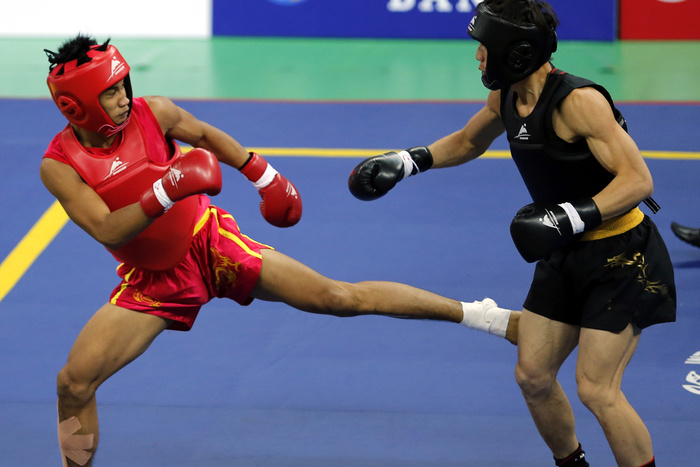
Muay Thai is the art of eight limbs we all know and love, but Sanda may be just as good a striking base for MMA. Sanda is a Chinese kung fu style, based around kickboxing and wrestling. Defending takedowns while still having the balance to land high kicks is the hall mark of Sanda which has led to several strong Sanda fighters in MMA.
Muslim Salikhov, the King of Kung Fu is the most accomplished being at one point in time the best fighter in his weight division. He now has an impressive UFC career and not unlike Cung Le (the original sanda fighter in MMA) uses the wrestling skill he learned from Sanda to keep himself standing. He can then comfortable out-strike his opponents as they fail to take him down.
The presence of takedowns is a clear advantage over Muay Thai, but in my honest opinion the main value of the takedowns in Sanda is that it can replace wrestling training. This will make some wrestlers scoff, and say that the nuances of wrestling aren’t present in Sanda. This is correct, and it is completely irrelevant because every set up you’ll ever learn in pure wrestling context is useless in MMA. The only thing wrestling training gives you is more experience finishing the takedown.
By training Sanda you not only learn HOW to take someone down – but you learn to do it within a striking context, meaning the bulk of your stand up training is already done.
How Do They Match Up?
Sanda (which we discussed more here) is contested on an open mat, as opposed to a ring or a cage, meaning that fighters from a sanda background may have more trouble cutting off the ring than Thai boxers. That being said the real trouble in deciding which is more practical for MMA, is that they both bring a unique advantage the other doesn’t have.
The trade off here is clinch, or more immediately practical takedowns and there isn’t a clear answer as to which is better. Muay Thai has a more varied striking arsenal than Sanda, which prohibits knees and elbows in competition, it also has a more reliable technique for kicks, landing on the shin rather than the foot.
While Sanda places more emphasis on spinning techniques and are no doubt better at them than Thai Boxers, spinning kicks aren’t a replacement for over all strategy. While it’s impressive and devastating to land one, I don’t think they are an advantage over Muay Thai.
The ideal striking art would be one that has both wrestling and clinch fighting.
Oh wait…
A Challenger approaches…

Shoot boxing is a sport that allows for all the legal techniques in Muay Thai, in addition to throws and standing submissions. The styles most famous practitioner is probably Andy Souwer, who competed in it regularly before going into K-1. The styles open and varied ruleset covers all aspects of MMA’s stand up.
While it’s true that you won’t learn elbows or takedowns with the same emphasis you may do in Muay Thai, or in Sanda respectively, that all these techniques are covered gives you experience in all of them, while in a setting to specifically train them all together in a dedicated competition.
There’s only one major flaw, which is that the sport and ways to train it are non-existent outside of Japan and will likely never make it overseas. So which is the best for MMA? I guess the answer is shootboxing, but good luck to you.