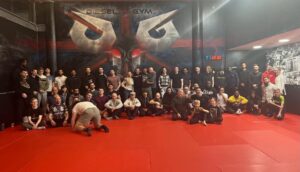

Today we have a guest piece from James Budd, who attended Vinny Shoreman’s Seminar at Diesel last week.
https://theshoremansolution.com/
Vinny Shoreman has a way with words, so much so that he’s made it his business. The former fighter and striking coach is now the most recognisable voice in European kickboxing, and one of the most prominent figures in combat sports psychology.
He isn’t a shy guy. His seminar at Diesel Gym has been underway for less than two minutes, and he’s already pointing to the poster of himself and Joe Rogan on the wall:
“I’ve been on four times you know. The only Brit to have been on Joe Rogan’s podcast four times! I’ve got his phone number, he never answers though.”
His jovial bragging gets a laugh, but in reality Vinny would much rather talk about his clients’ achievements than his own. There’s an air of humility to everything he says, acknowledging his own shortcomings at every step, but he runs out of superlatives whenever the eight time world champion Liam Harrison is mentioned, and has nothing but glowing praise for recent PFL featherweight tournament winner, Brendan Loughnane.
“Mindset is everything,” says the Enfusion and Yokkao commentator, whilst discussing his training in hypnotism and neurolinguistic programming, “life is never about being easy, pain hurts, fears exist, we have to galvanise our minds against them.” We are reminded that we are “warriors, not worriers,” and that we cannot avoid conflict or failure. Today’s seminar is about truthfulness, first and foremost. ‘Cards on the table’ as he calls it. We are told that successful people lie in order to excuse themselves of blame or responsibility, and that this behaviour will always lead to failure.
Being honest, true to yourself and recognising your own shortcomings is pivotal to progression in any aspect of development, be it competition or personal growth. If we lie to ourselves, those shortcomings will “echo around in our minds, becoming louder and louder,” he explains. Accountability is key, we must own our mistakes in order to overcome them, and we mustn’t allow them to rule over us.
What follows is a series of physical exercises combined with some basic therapy, aimed at revealing the limitations we place on ourselves through our perceived senses, and the power of finding your own personal motivators. There’s even a brief introduction to Hakalau, an ancient Hawaiian practice that uses peripheral vision to achieve a meditative state. Vinny acknowledges that not all of us will find all of the tools and methods useful. We can’t all find motivation in the words of David Goggins, I certainly don’t want to be reminded about my inner bitch on a daily basis. “Old school hip-hop works for me, find what works for you,” he says.
Much of the seminar is focused on the strength of focus and the ability to cut out distractions, explaining that fighters have to be selfish in order to succeed. “Don’t set yourself on fire to keep others warm,” he says, justifying the need for self-preservation in competition, “if your peers have negative opinions and you allow them to bring you down, that’s on you.”
With regards to keeping your nerve whilst preparing to compete and actually competing, Vinny recommends imagining yourself 15 minutes after the fight. This advice is almost an extension of one of the exercises from the seminar, seeing past your target and your perceived limits. Punching through the bag, so to speak.
Talking to each other – something that’s almost discouraged in the age of social media (ironically) – is a common theme. Vinny reminds us that although we’re all individuals, most of our fears are shared. Having a dependable community is key to addressing our problems and helping to overcome them. “Your gym is your village, your city, your country,” he declares.
I must admit, I came to the seminar with a rather cynical opinion of mind coaching. I have autism and ADHD, I’ve always found meditation impossible, and have never been able to achieve the mythical calm place that others seem to reach when training and fighting. When I asked Vinny about this, as an ADHD sufferer himself, he had a no nonsense answer:
“You’ll never find it. I’ve never found it. Don’t bother trying.”
And that’s the best advice I’ve had in a long, long time. Most people will try and sell you a cure, it’s refreshing to hear somebody give you the cold, hard facts. Instead of being sold a lie, I was advised to use the chaos to my advantage. Although I couldn’t reach the place he described in the final exercise of the seminar, my performance in the rest of the exercises improved after he’d worked his magic. I’m no longer cynical.
To conclude, in the ever-evolving world of combat sports, every aspect of a competitor’s life can be honed and trained to improve their performance. Fighters have regimented strength & conditioning, nutrition and recovery programs, it would be logical to apply a similar training routine to one’s mind. Even the most skilful athletes can come unstuck if they’re not mentally prepared, and those who refuse to face their fears will forever be haunted by them. The root of Vinny’s philosophy seems to be that honesty is the best policy. After all, you can’t lie your way out of being choked or knocked out.