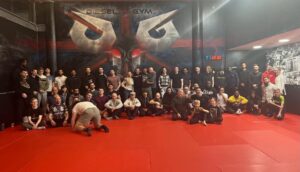

Editor’s note: This was an interview that I conducted on my own (24/11/2017) and have sold to other websites in the past. It is not only readable at Diesel Gym London’s website, and will remain so for the foreseeable future. This was conducted after what is currently Tarec’s last fight as a professional.
Tarec Saffiedine is a pioneer of mixed martial arts in Belgium. Coming from humble beginnings, doing everything he could to find competition, to taking a huge risk and moving to America to pursue his dream. This is the only English-language interview of Tarec Saffiedine telling his story:
Andrew: Thank you for agreeing to do this! Your UFC website profile, says you were inspired to take up MMA because of one of your favourite manga series, is that true?
Tarec: You are very welcome. Yes, it’s part of it. I started taekwondo at the end of 2002, then I discovered the manga TOUGH, which talks about MMA and that’s how I switched from taekwondo to Shihaishinkai Karate, which is a form of martial art close to MMA.
Andrew: So, what are the rules of Shihaishinkai compared to other karate styles?
Tarec: The basics of shihaishinkai are really close to Kyokushinkai Karate, but we also trained in Muay Thai, boxing, judo and grappling. I used to compete in Muay Thai then the week after I would o a grappling tournament in Holland, then to a Karate tournament in France the week after.
Andrew: Because you spent your early career in Belgium, you got to take on people from both borders?
Tarec: Yes, I used to travel everywhere. Belgium didn’t offer much in terms of competition back in the day, I had to go to France, Holland, England, Finland, Germany and also different places in Belgium to get a good quality tournament. Lots of driving and waking up early in the morning but it was worth it.
Andrew: That’s the part of being a fighter the fans of ten miss – when you’re just starting out it can be tough to even get a fight.
Tarec: Tell me about it.
Andrew: So, TOUGH was sort of like your Rocky.
Tarec: Yeah, kind of. The story of the books hero was inspiring to me, the martial art way, the way he learned from his father etc. I was replicating the technique of the books. I still have the manga in my book shelf haha. That’s not the entire story of why I started, it just fired the desire to start.
Andrew: As much as I’m a big comic and manga fan, I’d really like to know the rest of the story.
Tarec: When I discovered the manga, at the end of each volume there is an bio of a famous fighter like Rickson (Gracie) or (Enson) Inoue etc… and I started watching their fights online. One friend used to train too, and he invited my to train at the gym at our high school. We would put some mats on the floor and beat each other up every day after school. I twas fun but we only learned from video and didn’t have trainers at that time. So I looked for a trainer and found shihaishinkai, after I fed up of Taekwondo, because there were no tournaments for it in Belgium.
I grew up playing different sport. I started judo ay 4 years old but I hated it, so I stopped after few weeks. I wasn’t a trouble maker, I had my share of bullying in high school which also motivated me to learn how to defend myself and be more confident
Andrew: I was the same, a lot of people expect fighters to be mean – and don’t realise they became fighters to protect themselves.
Tarec: I think for me it was everything together at the same time, from being bully, willing to defend myself and also discovering the manga. everything happened at the same time kind of.
Andrew: It clearly worked out for you, first Belgian to fight in the UFC.
Tarec: Yes, it was my goal when I left for the US.
Andrew: Can you tell me more about that? You literally made history.
Tarec: When I started training, that’s all I could think about, even in high school. I would go straight to the gym and train for hours. I would compete as much as I could, but Belgium and MMA don’t fit together. There were no fights or opportunities in 2005-2006 like there is today. So after my first pro fight in 2007, I thought either I do this as a hobby and find a job, or I take a chance and try to make it to the US where the competition is.
Andrew: That’s a huge risk for a young man to take.
Tarec: There were more opportunities there, so that’s what I did. When I left I had 2 goals, become the 1st Belgium to become a world champion, and the first Belgian to go to the UFC. I was young and I was sleeping, breathing, training and fighting. I didn’t care about anything else so when the opportunity presented itself to go train in the US, I didn’t think twice.
Andrew: Your Strikeforce Title win against Nate Marquadt was a blow out victory, so it paid off.
Tarec: Thank you! It was a long camp, tough camp, but I was well prepared for that fight.
Andrew: It’s interesting, originally, I was going to ask what changed you had to make to your style in order for it to work in MMA, but it sounds like you didn’t really have to. I watched a video from your first karate tournament, and even though you obviously improved from then to now, it seemed like you wore that opponent down in the same way you wore Nate down.
Tarec: I think what I really had to improve was my wrestling when I came to the US. I was getting beat up by wrestler and I couldn’t strike because I was getting taking down so I had to learn that aspect. If I didn’t have good takedown defence for Nate, it would have been a different fight.
Andrew: It’s frustrating isn’t it? Training wrestling is tiring even without an NCAA guy blasting doubles at you. You’re quite hard to take down now though, and the BJJ black belt to keep you safe on the ground.
Tarec: Yes, I really had to learn how to defend takedowns in order to implement my striking game. Nowadays you have to be more than complete to compete, the game has evolved so much.
Andrew: As a fighter you normally win by decision, and I notice that you’re able to control fight with nothing but a solid jab and leg kicks, and that’s something very few fighters are able to do. Do you think your approach to leg kicks is different from the average MMA fighter?
Tarec: I think that very few MMA fighters know how to utilise kicks effectively. It’s such an effective weapon, especially because nobody knows how to block them. Obviously you have to be aware of takedowns but two good low kicks and your opponents wheels are gone. No more bases, no more takedowns.
It’s not just kicks though, you have to have effective distancing.
Andrew: And you start out with lighter kicks and then bang in heavier and heavier ones as the fight goes on. Not to mention the surprise kicks like the Brazilian kick (Question Mark Kick if you’re an uncultured normie reading this).
Tarec: I like that kick, I haven’t been able to use it effectively in a fight yet though. It’s a beautiful kick, very technical and very powerful.
Andrew: Hopefully you get a Glaube Feitosa style KO with it one day.
Tarec: Haha, yes he was the master at that kick!
Andrew: I was thinking on what you said about distancing earlier. I think that’s why so many fighters struggle to get a clear rear on you, it seems like you’re always just out of punching range and leg kicking them, it’s like they get so worried about the kicks they panic, but that just makes them run onto more of them.
Tarec: I think MMA is all a game of distance and strengths. Whether you’re a wrestler, striker, boxer, grappler etc. You have to get your distance to use your weapons effectively. Otherwise you give up that distance for your opponent.
Editor’s note: You can learn more about maintaining distance onthis Diesel Gym London article.
Andrew: Okay I have two more, and then I’ll let you go!
Tarec: No worries, I’m enjoying it.
Andrew: MMA fans still seem surprised whenever they hear of a UFC calibre fighter coming from a karate background. Do you think that we’re still under rating karate, or are there just not enough good karateka coming up in the sport.
Tarec: I think there are different styles of karate, Machida and Wonderboy have similar styles, but I come from a different style. It’s like Shotokan vs Kyokushin, I think every style has its chance in MMA as long as you’re willing to learn the other necessary styles that come with the sport of MMA. You can’t just come with karate and not learn wrestling. That would be insane.
… but if you come from Aikidi, it would be REALLY hard to transition into MMA, hahaha. So maybe not EVERY style.
Andrew: They don’t even train with resistance! So for you, what is the most important thing a fighter can learn?
Tarec: The will to improve and learn new things. To adapt to the constant evolving game but for that, you need to be well surrounded with people that are willing to let you learn new things. Open minded people.
Andrew: Wise words. Thanks a bunch for today, it’s been great. I’ve got a lot to work with, I hope it was different from the interviews people normally do!
Tarec: Yes that was great. You are very welcome.