When people refer to ‘oblique kicks’ they are referring to two types of kick, neither of which target the oblique; teeps to the knee and side kicks to the knee. These two techniques have essentially made it so that slow plodding brawlers are unable to close no man’s land (more here).
They are also the source of one of the most laughable controversies in mixed martial arts history.
Today we are looking at why kicks to the knees are completely acceptable to use in competition, and how to defend them.
So what’s the deal with kicks to the knee?
From MMA forums, to angry Facebook comments, we see people positively shook by oblique kicks. These dangerous kicks that target the knee, injuring it and ending the careers of fighters in a shocking display of unsportsmanlike conduct.
In reality however, the so called ‘career ending kicks’ have never ended the career of a single notable fighter. In spite of their popularity in MMA, Muay Thai and being a basic fundamental of Savate, we would have at least one example of a fighter being forced to retire due to knee kicks, yet we don’t. Instead what we get are essentially pub stories of ‘a guy I know’ who’s career was ended by a kick to the knee, with no proof the guy even exists. It is the MMA equivalent to the millionaire homeless man who everyone’s friend seems to know about.
The nastiest oblique kick we’ve ever seen was dealt to Miguel Torres, who lost the fight on a decision and then fought six months later with no issues. This hasn’t stopped fighters from complaining though. Rampage Jackson argues its unsporting, and a ‘career ender’, ironic given Rampage Jackson’s penchant for straight up slamming his opponents heads off the canvas, WWE style.
Meanwhile in Muay Thai, we seemingly have an endless supply of people who practise Muay Thai and don’t even know the rules. Leading to the bizarre notion that oblique kicks are not ‘legal’ in Muay Thai.
Here is a wholly unrelated video of former Rajadamnnern Champion, Malaipet teaching you how to oblique kick:
The International Kickboxing Federation prohibits thrusting kicks, 6 inches above or below the knee, but in reality, no referee will be getting the ruler out to check the distance of the kick from your knee. So even in a ruleset where they are technically illegal, you will have to deal with them. However, this is just one governing body, and far from the be-all-end-all. In fact it was the only example I could find where the techniques are prohibited.
The IFMA (the only recognised body for Amateur Muay Thai) does not list kicks to the knee anywhere on its list of fouls.
The World Muay Thai Council, the foremost Muay Thai association, also allows the techniques. They are allowed in Lumpinee and Rajadamnern Stadium and indeed any stadium you go to in Thailand.
Finally, they are not prohibited by the UK Muay Thai Federation rules either.
A common weasel tactic is to say that the teeps used to the leg in Muay Thai target the thigh and not the knee, and that kicks to the knee are different. Or that a thigh teep is not the same as an oblique kick because the angle of the foot is different. I will be harsh and say these are outright lies told by people who just don’t like the move and would rather see it banned than learn to defend it.
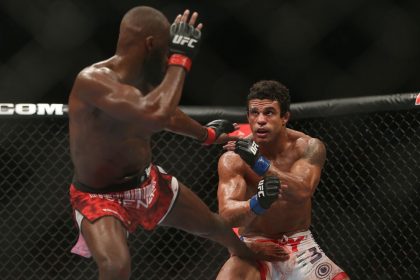
Jon Jones does not kick the kneecap, he kicks the thigh, the thigh is a bigger, longer, easier target and it doesn’t involve him kicking into bone. Nobody when throwing a knee kick, actually targets the knee. These kicks always target the thigh.
If you’re told by a referee not to do it under a sanctioning body that permits the techniques (which is most of them), listen to the referee – but do complain about it after. This technique is legal and if you are a fighter in a sport that allows it you need to know how to defend it. So how do we do it?
How to Defend
To find easy defences all we have to do is look to Savate, the French kickboxing sport where kicks to the knee are most common. In MMA they are considered controversial, in Savate, they are a staple. Savate is an often overlooked, and very important martial art. Without Savate, Karate and Taekwondo as they are known today do not exist, as early Karate’s kicking arsenal was adopted from Savate.
The oblique kick or chasse bas (‘Get-Away Kick’) as it is known in the Savate, is not only common, but it is performed with shoes, which mean that there is already more grip, making the technique less likely to slip off. As a result Savateurs (yes that’s actually what they are called) must have the defence for them ingrained as part of their fundamentals.
Just like with any defence, a good fighter should have multiple layers of defence protecting themselves from kicks. First we have prevention, then we have a specific defence and counter. If you are doing both well, you shouldn’t have to worry too much about oblique kicks. This isn’t to say that you’ll never be hit with them, you can’t swim without getting wet, but they will just be another challenge to deal with.
Preventing Kicks
Light Lead Leg
This is the Muay Thai approach to defending these sorts of attacks, while completely legal and used, part of the reason you don’t see oblique kicks used in Muay Thai the same way they are in MMA is due to weight distribution.
By standing light on your lead foot, the oblique kick can’t hyperextend or jolt the knee. This is the first thing to experiment with – and will definitely be harder for fighters who like to brawl – but it’s important to be able to shift between a rear heavy and front heavy stance in Muay Thai, regardless of what techniques your opponent uses.
Lateral Movement
By far the easiest and most reliable method, employing good lateral movement shuts down not just knee kicks but all linear kicks. The best example of this is Gustafsson completely shutting down Jon Jones’ use of the kicks in their first fight.
Whenever Jones threw an oblique kick it just sailed past Gustafsson’s leg and he would re-enter on an angle and light Jones up with punches. Being able to get past this is largely why Gustafsson was able to shock Jones in what is probably the best title fight in UFC History, one that is controversial to this very day (You can read more on that fight here)
Front Kicks and Teeps
By being reactive with a straight kick to the body, you can knock an opponent off balance whenever you see them pick up their leg. This not only shuts down their knee kicks but will help to shut down their offence in general.
Teeps generally stop everything, and in Muay Thai everyone is good at teeping, which is why you don’t see tons of knee kicks, in addition to the lead leg being light. For a good MMA example of this working we have Robert Whittaker using them against Yoel Romero.
Stopping an Oncoming Kick
Retracting the leg
When you see a kick coming, retract the leg (without changing your stance), before pushing off your back foot to step in with counter punches after their kick falls short. This method requires good timing, but will immediately let you return fire.
Stance Switching
Alternatively, if the opponent’s kicks are particularly strong, being ready to step back into another stance will again cause their kick to fall short, and set you up for an easy body kick, or shifting punch.
We can see both these methods demonstrated by Savate Champion James Southwood here:
Kicking Your Foot Up
An incredibly easy method is to simply just pick your leg up. As demonstrated by Ramsey Dewey here:
This is particularly important if you are the fighter advancing on a straight line, which at some point against the knee kicker you will have to do.
Lateral movement is something a fighter should be doing anyway, and I think it says something about the level of striking and footwork in MMA that we see so few fighters with legitimately good lateral movement; for every Eddie Alvarez or Israel Adesanya we have 5 fighters in the Rampage mould of ‘step forward and punch’.
If you make a habit of drilling these defences the same way you would any other defensive technique, these kicks should be as easy to defend as anything else. Just don’t get so caught up in defending these kicks that you forget to defend your head, because those are where the real career ending injuries happen.
Diesel Gym London